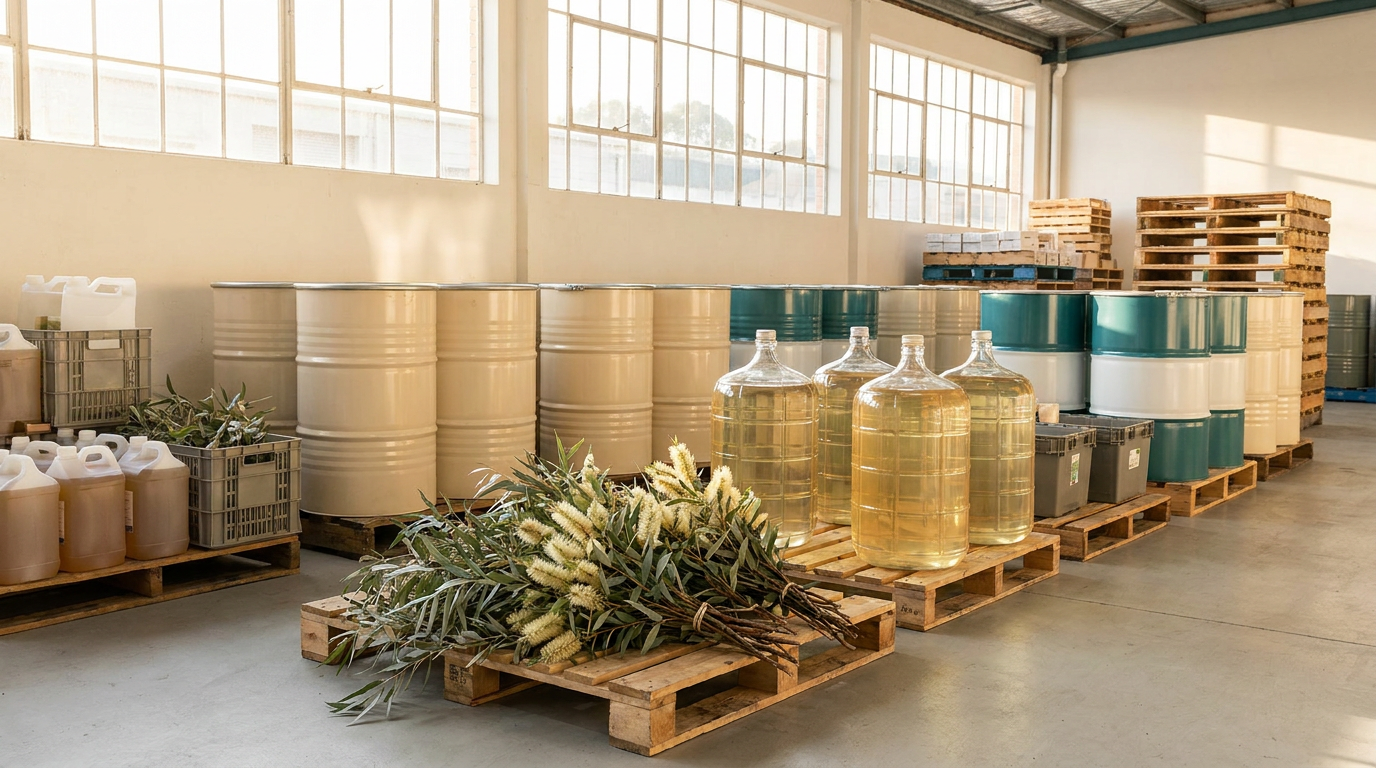
Cajeput essential oil is a fresh, cool, fruity-camphorous top note distilled from the paperbark tree of Southeast Asia, and it has become a working ingredient for home fragrance houses, cleaning product formulators, and craft studios that need a crisp, clean-smelling note at production scale. Buying it wholesale means understanding how the oil is graded, what the real market looks like, and which documentation actually backs up a bottle.
Order a sample size and run it in your own formulation before committing to a bulk order.
Cajeput comes from Melaleuca cajuputi, a tall paperbark tree that grows in the wetlands of Indonesia, Vietnam, and Timor-Leste. Island distillers steam the fresh leaves and twigs, a method covered in detail in how the oil is made, and the result carries the tree's own botanical identity straight into the bottle.
What sets cajeput apart from other leaf oils on a formulator's bench is its chemistry. The oil's crisp, camphor-like top note comes largely from its cineole content, a relationship explained in the chemistry behind the scent, and the practical result is a fresh, cool, fruity-camphorous profile that reads brighter and sweeter than many other leaf oils.
Origin matters at wholesale scale. Buyers sourcing by the pound should understand how Indonesian, Vietnamese, and Timor-Leste lots can differ in character, a distinction laid out in buying cajeput oil by origin, before committing to a large order.
| Sold as | What it actually is | How to recognize it |
|---|---|---|
| Cajeput Oil, plainly labeled | A single-origin distillate of Melaleuca cajuputi leaf and twig, sold under its own botanical name | The label states the species and origin and links to a lot-specific Certificate of Analysis |
| Rectified or Redistilled Cajeput | Oil that has been redistilled to strip color and trace impurities | A near-colorless appearance and a higher per-pound price than a standard first-distillation lot |
| Cajeput Fragrance Oil or Cajeput Blend | A scent built from eucalyptus oil, synthetic camphor aromachemicals, or both, meant to approximate cajeput cheaply | Vague labeling with no botanical name, no origin, and no published Certificate of Analysis |
| Minyak Kayu Putih | The everyday Southeast Asian retail name for cajeput oil, often already cut with a carrier oil for local household sale | A low per-bottle price and a label that lists a carrier oil alongside the cajeput |
None of these variants is inherently a problem on its own terms; rectified oil and regional retail cuts both serve real markets. The issue for a wholesale buyer is when any of the three gets relabeled as a straight, single-origin cajeput oil without disclosure.
The sourcing trap is simple: the cheapest per-ounce quote is almost always a fragrance-oil cut or a pre-diluted retail product wearing a cajeput label, not a sign of a fair price from a legitimate distiller. A published, lot-specific Certificate of Analysis and a plainly stated botanical name are the fastest way to rule out both.
The real buyers for cajeput at pound and drum scale cluster around a handful of categories: home fragrance and diffuser blend houses, cleaning and household spray formulators, soap and craft studios, and spa or massage oil studios that want a crisp, non-floral note in their service menu. Each is looking for the same fresh, cool, fruity-camphorous character described in the FAQ on the oil, just applied at different scale and dilution.
What unites them is formulation intent rather than industry label. A perfumer blending a crisp top note, a cleaning brand chasing a bright non-floral scent, and a home fragrance brand building a diffuser blend all want the same aromatic backbone, which is why the blending guide is a useful reference regardless of which finished category a buyer sits in.
Before placing a bulk order, a buyer should be able to check off the following:
Documentation is the whole ballgame at wholesale scale: a buyer who insists on a lot-specific Certificate of Analysis before committing to a drum-level order, and who keeps that document on file, has already solved most of the sourcing problems described above. This site publishes its own batch COA at /docs/cajeputessentialoil-coa.pdf for exactly that reason.
Cajeput is sold here across nine sizes, from a half-ounce sample bottle meant for bench testing up to a four-hundred-pound drum for full production runs. Most wholesale buyers move through the range in stages rather than jumping straight to the largest size.
Full pricing across the bulk tiers, including the per-pound rate at each size, is posted on the /bulk/ page.
Order a half-ounce or one-ounce bottle to run a bench test in an actual formulation, not just a sniff test straight from the vial.
Test the oil at the dilution and blend ratio intended for the finished product, checking how it holds up against carriers, waxes, or cleaning bases already in use.
Move to a five-pound or twenty-five-pound size once the formulation is locked, requesting the lot-specific Certificate of Analysis before the order ships.
Step up to the four-hundred-pound drum for full production runs, and set a reorder schedule against the oil's typical two-to-three-year shelf life so stock stays fresh through the run.
The sections below break out the specific wholesale categories that buy cajeput oil in volume, along with what each one should look for in a supplier.
Diffuser blend and room fragrance brands use cajeput for a crisp, non-floral top note that cuts through heavier base notes.
Read the sourcing guide →Cleaning brands use cajeput's sharp, fresh top note to give surface sprays and multi-purpose cleaners a clean-smelling edge without a floral or sweet cast.
Read the sourcing guide →Soap makers and craft studios use cajeput for a sharp, clean scent in cold-process bars, solid colognes, and other bench-made goods.
Read the sourcing guide →Freshener sachet and insert makers use cajeput's sharp, penetrating scent to cut through confined, stale-air spaces like closets, shoes, and gym bags.
Read the sourcing guide →Fragrance houses use cajeput as a top note in camphoraceous and fresh-leaning accords, valued for the same crisp lift perfumers get from eucalyptus or rosemary.
Read the sourcing guide →Spa studios and massage oil brands use cajeput at low dilution for a crisp, invigorating scent in body oil and bath blends.
Read the sourcing guide →Vent clip and diffuser disc manufacturers use cajeput for a sharp, clean scent that reads through a car's small, closed cabin.
Read the sourcing guide →Reach out through /contact/ for pricing on drum-scale quantities, or review sizing directly on /bulk/.